Imagine you're standing in a calm pond, and you throw a stone in.
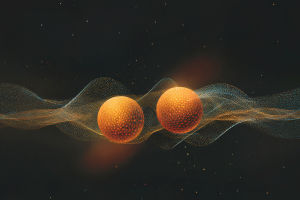
The ripple spreads out across the surface, moving outward in every direction. Now, picture that the surface of the pond is the fabric of space-time, and the stone represents an event so powerful that it creates waves—waves that travel across the universe. These are gravitational waves. But what exactly are they, and how do they change the way we study space?
What Are Gravitational Waves?
Gravitational waves are tiny ripples in the fabric of space-time, created by some of the most extreme and violent events in the universe, like colliding black holes or exploding stars. These waves were first predicted by Albert Einstein in 1915, as part of his General Theory of Relativity.
1. The Concept: According to Einstein's theory, massive objects warp the space around them. When such objects move, especially in an intense way, they cause the space around them to ripple. These ripples—gravitational waves—travel at the speed of light.
2. Detection: Gravitational waves are incredibly faint. They stretch and squeeze space by tiny amounts, often smaller than an atom. That's why detecting them has been such a challenge. But in 2015, scientists at the LIGO (Laser Interferometer Gravitational-Wave Observatory) finally succeeded in observing these ripples, confirming Einstein's century-old prediction.
How Gravitational Waves Are Created
Gravitational waves come from a variety of cosmic events, but the most powerful ones arise from:
1. Black Hole Mergers: When two black holes spiral toward each other and eventually collide, they release an enormous amount of energy in the form of gravitational waves. This was the first event detected by LIGO in 2015, and it was so intense that it caused a detectable ripple across space-time.
2. Supernova Explosions: When massive stars explode in a supernova, the sudden collapse of the star's core can create gravitational waves. These waves carry the story of the explosion, allowing scientists to study distant stars and galaxies in new ways.
3. Neutron Star Mergers: Neutron stars are incredibly dense remnants of massive stars. When two neutron stars collide, they can produce both gravitational waves and electromagnetic radiation, like gamma rays. These types of mergers have been particularly exciting because they offer new insights into the behavior of matter under extreme conditions.
The Impact on Astronomy
Before gravitational waves were detected, astronomers primarily relied on light (visible, radio, X-rays, etc.) to study the universe. However, light has limitations—it can be blocked by dust, absorbed, or scattered as it travels across space. Gravitational waves, on the other hand, pass through matter without being affected.
1. A New Way to "See" the Universe: Gravitational waves give us a new tool to observe the universe, especially events that we couldn't detect with traditional telescopes. For example, while gamma-ray bursts can be blocked by dust, gravitational waves from a black hole merger can travel undisturbed, carrying information across billions of light-years.
2. Revealing the Hidden Universe: Many of the most violent events in space, like black hole mergers or neutron star collisions, don't emit traditional light. But they do release gravitational waves. This means that we can now study the most extreme environments in the universe that were once invisible to us.
Example: The detection of gravitational waves from a neutron star merger in 2017 was groundbreaking. Not only did it confirm the existence of these waves, but it also allowed scientists to study how elements like gold and platinum are formed during such events.
Gravitational Waves and the Future of Space Exploration
Gravitational wave astronomy is still in its infancy, but the potential for discovery is immense. As our technology improves, scientists believe we'll be able to detect even fainter waves from more distant events.
1. Precision Measurement: Future detectors will be more sensitive, allowing us to observe even more distant events. With more accurate measurements, scientists can probe deeper into space and time, uncovering the secrets of the early universe.
2. Studying Black Holes and Dark Matter: Gravitational waves can help us understand black holes and dark matter—two of the biggest mysteries in astrophysics. By studying the properties of gravitational waves from different sources, scientists can learn more about the structure of these objects and how they influence the universe.
3. Testing Einstein's Theory: Every time we detect gravitational waves, we're essentially testing Einstein's theory of relativity. Future observations could help us refine or even challenge our current understanding of physics. For example, scientists are now studying whether gravitational waves behave exactly as predicted by Einstein or if there are any anomalies that could indicate new physics.
Challenges and Limitations
Despite its enormous potential, gravitational wave detection is still a challenging field. The signals are incredibly weak, and they're often drowned out by other sources of noise, such as seismic activity or even the vibrations caused by passing trucks. Overcoming these challenges will require better instruments and more advanced technologies.
1. Technological Hurdles: Current gravitational wave detectors like LIGO and Virgo are extremely sensitive but can still only detect the most massive cosmic events. Newer detectors are being developed, such as space-based observatories like LISA (Laser Interferometer Space Antenna), which will be able to detect much weaker gravitational waves.
2. Data Overload: The signals are faint, and distinguishing meaningful waves from noise requires sophisticated data analysis techniques. As detection capabilities improve, the volume of data collected will likely increase, requiring more advanced computational tools to analyze it.
Conclusion: Gravitational Waves and Our Understanding of the Universe
Gravitational waves are one of the most exciting discoveries in modern science. They allow us to study the universe in a way that was previously unimaginable. With each new detection, we're not just learning about distant cosmic events; we're gaining deeper insights into the fabric of space-time itself.
In the future, as detection technology improves, gravitational waves will continue to reshape our understanding of space. They'll help us explore the most extreme environments in the universe, uncover the mysteries of black holes and dark matter, and potentially even challenge the very laws of physics as we know them. The universe has just begun to reveal its secrets to us—thanks to the power of gravitational waves.